
VA Mental Health Nexus Letters: What They Are, What They Are Not, and How They Compare to DBQs and Independent Medical Examinations


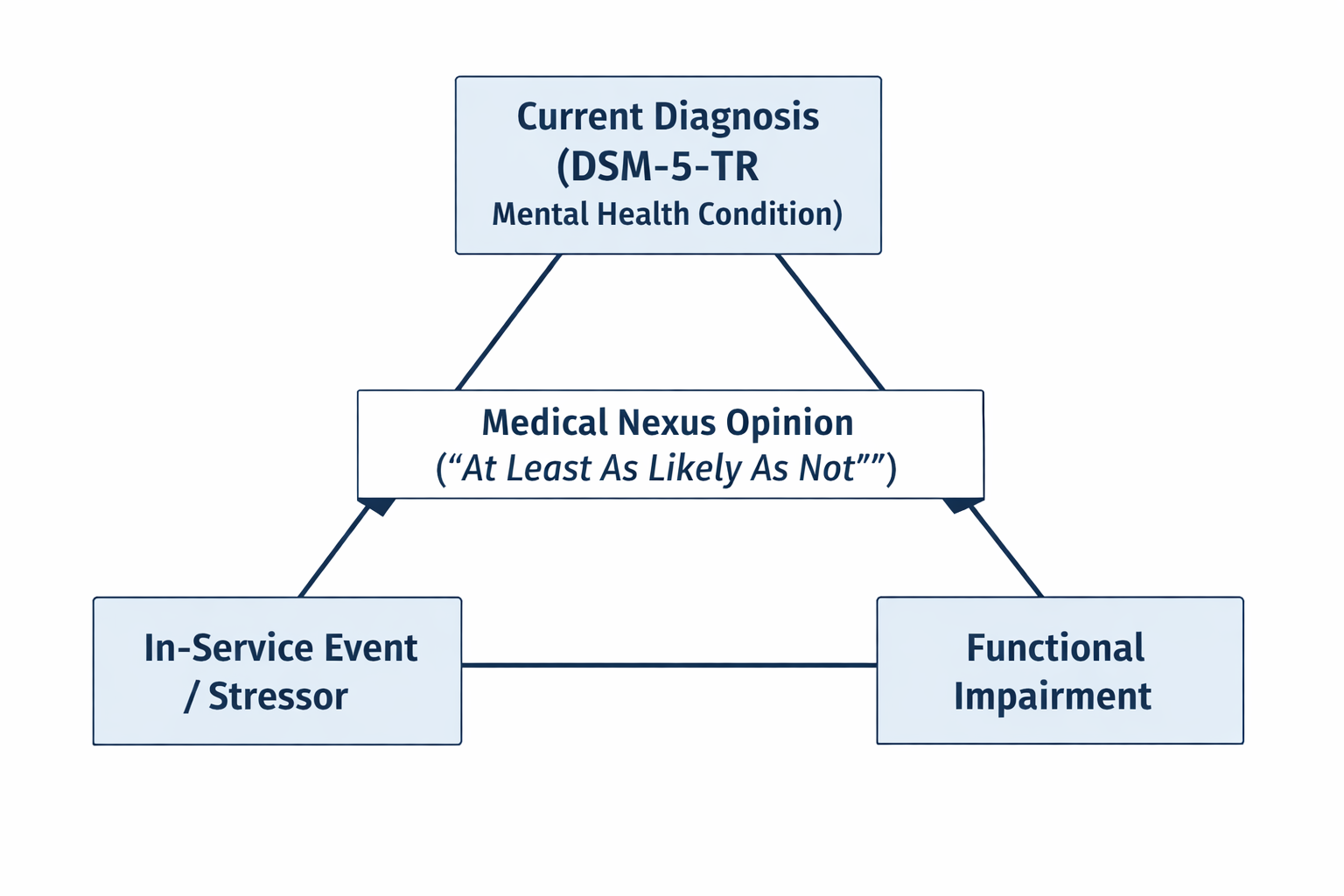
- A nexus opinion is the medical link the VA requires to connect a current condition to military service. Without one, even documented symptoms may not qualify for service connection.
- Not all nexus opinions carry the same evidentiary weight. The strength of the opinion depends on the depth of the clinical evaluation behind it, including records reviewed, interview length, and diagnostic reasoning.
- Every psychological IME includes a nexus opinion. Not every nexus letter reflects an IME-level evaluation. One states the conclusion. The other documents the work behind it.
- Under 38 CFR §3.159, competent medical evidence must come from a qualified provider and include sufficient rationale. An opinion that states a conclusion without explaining the reasoning may carry less probative value.
- If your claim was denied, your C&P exam was brief, or you are preparing an appeal, a full psychological IME may provide a stronger evidentiary foundation than a standalone nexus letter.
- The Core Distinction Between a Nexus Letter and a Full Psychological IME
- Compare Nexus Letter vs. DBQ vs. Psychological IME
- What Is a Nexus Opinion in a VA Disability Claim?
- Why Nexus Opinions Matter in Mental Health Claims
- Secondary Service Connections in Mental Health Claims
- Who Can Write a Mental Health Nexus Opinion?
- When Should a Veteran Consider an Independent Medical Examination?
- What Is Included in a Full Psychological IME?
- Common Mental Health Conditions Evaluated in VA Claims
- Evidence, Not Promises
- Common Questions
Treating Provider Note
May support a claim when service records are already strong. Clinical rationale is typically limited.
Nexus Letter
States a service connection opinion. Evidentiary strength depends entirely on the clinical depth behind it.
Disability Benefits Questionnaire (DBQ)
Structured VA form. Documents findings but narrative depth and rationale vary significantly by provider.
Full Psychological IME
Clinical interview, comprehensive records review, DSM-5-TR diagnostic assessment, and documented medical rationale. Most comprehensive form of independent medical evidence.
Many cases begin with a treating provider note or nexus letter and that is appropriate when the record already supports the claim. When stronger independent medical evidence is needed, a full psychological IME may be the right next step. The level of evaluation often determines how much weight the opinion carries on review or appeal.
Dr. Willoughby & Associates is a practice of licensed PhD and PsyD psychologists who conduct psychological Independent Medical Examinations for veterans pursuing VA disability claims. We have a direct interest in this topic, and we want to name that clearly.
This article compares nexus letters, DBQs, and full psychological IMEs. Our practice provides IMEs. That creates an obvious tension worth acknowledging: we are explaining a spectrum of evidence while offering one type of it.
Our position is not that every veteran needs a full IME. When service treatment records are strong and the nexus is already clear, simpler evidence is often sufficient. This article is written to inform that decision, not to make it for you.
The Core Distinction Between a Nexus Letter and a Full Psychological IME
Every IME includes a nexus opinion. Not every nexus letter reflects an IME-level evaluation.
An IME can serve the same function as a nexus letter, but it also shows how the evidence satisfies the "at least as likely as not" threshold under 38 CFR §3.159. That documented thoroughness is what makes it stronger evidence.
A typical nexus letter may be one to two pages. A full IME is generally five to eight pages because it builds and documents the evidentiary foundation behind the conclusion.
One states the opinion. The other shows the work behind it.
When a case is reviewed by a rater, Higher-Level Reviewer, or the Board of Veterans' Appeals, the thoroughness of documentation and clarity of medical reasoning often influence the weight an opinion carries.
To learn more about what is actually happening with VA scrutiny on nexus letters and what the evidence actually requires, read our full guide.
Compare Nexus Letter vs. DBQ vs. Psychological IME
| Criterion | Nexus Letter | DBQ | Psychological IME |
|---|---|---|---|
| Length | ⚠ Typically 1–2 pages | ⚠ VA form, varies | ✓ 5–8 page comprehensive report |
| Evaluator | ⚠ Treating or outside provider | ⚠ VA or private provider | ✓ Licensed PhD or PsyD psychologist |
| Clinical Interview | ⚠ Often not included | ⚠ Varies by provider | ✓ 50–90 minutes, structured |
| DSM-5-TR Diagnosis | ⚠ Often not formally documented | ⚠ Required, but rationale varies | ✓ Yes, when clinically indicated |
| Meets 38 CFR §3.159 | ⚠ May not fully document VA evidentiary criteria | ⚠ Structured but limited narrative depth | ✓ Yes, with documented rationale |
| Evidentiary Weight | ⚠ Typically lower than a full IME | ⚠ Typically lower than a full IME | ✓ Most comprehensive |
| Appeal Strength | ⚠ Often less robust | ⚠ Varies by documentation depth | ✓ Most comprehensive |
Can a psychological IME be used in place of a nexus letter? Yes, and it goes further. Every IME we provide includes a full nexus opinion. The difference is what surrounds it: a 50 to 90 minute clinical interview, a DSM-5-TR diagnostic assessment, comprehensive records review, and detailed medical rationale explaining how the evidence supports the conclusion. Conducted by a licensed psychologist who is an employee of the practice, never a contractor.
A nexus letter states the opinion. An IME shows the work behind it, and that work is what VA adjudicators and appeals boards weigh when opinions conflict.
A free preliminary record review is the right starting point. A licensed psychologist reviews your file and tells you plainly whether stronger independent evidence is likely to help.
Request a Free Record Review No fee. No obligation. No pressure to proceed.Free Interactive VA Mental Health Evidence Review
Answer 6 brief questions to understand whether your file may need stronger independent medical evidence. No email required to view your result.
What Is a Nexus Opinion in a VA Disability Claim?
In VA disability law, a nexus is a medical opinion stating whether a veteran's current condition is "at least as likely as not" related to military service.
The phrase "at least as likely as not" reflects a 50 percent or greater probability standard. It is not a casual phrase. It is a defined evidentiary threshold.
Under 38 CFR §3.159, competent medical evidence must be provided by someone qualified through education, training, or experience, and it must contain sufficient rationale to be considered probative.
A nexus opinion is not simply agreement with a veteran's belief. It is a medical determination supported by clinical reasoning, record review, and diagnostic analysis.
A nexus opinion is not a form you fill out. It is a medical determination that has to be earned through the evaluation behind it. The conclusion is only as strong as the clinical work that produced it.
Without a clearly reasoned nexus opinion, even documented symptoms may not be connected to service for rating purposes.
Why Nexus Opinions Matter in Mental Health Claims
Mental health claims are frequently denied for reasons that have nothing to do with whether symptoms are real. They are denied because the medical evidence does not clearly document the connection, explain the reasoning, or establish functional impact in the record. The VA is evidence-driven. Decision makers assess the probative value of opinions based on the clarity of reasoning, factual foundation, and supporting documentation.
If a nexus opinion is pursued, its durability often depends entirely on how it was developed.
Comprehensive Records Review
The opinion clearly documents which service and medical records were reviewed and integrates them into the clinical reasoning. Opinions based on limited or undocumented record review carry less probative weight.
Clear Diagnostic Formulation
A DSM-5-TR diagnostic assessment explains how the criteria are met and why. Confirming a diagnosis without explaining the basis for it leaves a gap that VA examiners and reviewers can challenge.
Documented Symptom History and Progression
The opinion explains when symptoms began, how they progressed over time, and how they connect to the in-service event or stressor. Gaps in this timeline are a common basis for denial.
Functional Impairment Analysis
VA ratings are tied to how symptoms affect occupational and social functioning. An opinion that names a diagnosis without documenting its daily impact leaves the rating decision without the evidence it needs.
Stated Probability in VA-Recognized Language
The nexus conclusion uses the "at least as likely as not" threshold as defined under 38 CFR §3.159, reflecting a 50 percent or greater probability standard, and explains the reasoning behind that conclusion.
An opinion that simply states a conclusion without explaining the reasoning behind it may carry less evidentiary weight than one that documents the clinical and analytical process. For that reason, some veterans choose to pursue a full Independent Medical Examination rather than a brief standalone nexus letter. The distinction is not the title of the document. It is the depth of evaluation supporting it.
For a detailed look at how these differences play out in actual VA claims, see our guide comparing psychological IMEs and C&P exams.
Secondary Service Connections in Mental Health Claims
In some VA disability claims, the nexus opinion does not connect a mental health condition directly to military service, but to another service-connected condition. These are referred to as secondary service connections.
For example, chronic physical conditions can contribute to sleep disruption, stress, or functional impairment over time. In some cases, veterans pursue claims where mental health conditions develop secondary to service-connected tinnitus or other service-connected physical conditions already recognized by the VA. The medical opinion in these cases must explain the step-wise clinical progression, not simply assert the relationship.
Example: Secondary Clinical Pathway
Persistent symptoms interfere with sleep, daily functioning, and physical comfort over time
Sustained disruption contributes to mood instability, emotional dysregulation, and psychological stress
Meets DSM-5-TR diagnostic criteria when documented through structured clinical interview and records review
Who Can Write a Mental Health Nexus Opinion?
Under 38 CFR §3.159, competent medical evidence must come from a provider qualified through education, training, or experience. In mental health claims, this typically means a licensed psychologist, psychiatrist, or in some cases another appropriately credentialed mental health professional.
But qualification alone does not determine the weight an opinion carries. A treating provider who has known a veteran for years and a psychologist conducting a structured independent medical-legal evaluation are both potentially qualified under the regulation. They are not doing the same thing.
A treating provider's focus is symptom relief and ongoing clinical care. A medical-legal evaluator's focus is documentation, record integration, diagnostic formulation, and evidentiary reasoning built specifically to meet VA standards. Both roles are valuable. Only one of them is designed to produce competent medical evidence for a VA claim. That distinction is what VA adjudicators and appeals boards weigh when opinions conflict.
When Should a Veteran Consider an Independent Medical Examination?
A comprehensive evaluation is often considered when:
- A prior claim was denied for lack of service connection
- A C&P exam was brief or lacked detailed rationale
- There are conflicting medical opinions in the file
- The case involves complex trauma history or delayed onset
- An appeal requires stronger evidentiary support
- A physical disability like tinnitus or chronic pain has contributed to a new psychiatric diagnosis. Read more about establishing secondary service connection for mental health conditions.
Some veterans also elect to obtain a comprehensive IME at the initial claim stage in order to present a fully developed medical record from the outset.
Ethical evaluators decline cases where the evidence does not support a medically defensible connection.
Mental Health Conditions in VA Disability Claims
Psychological IMEs apply across a range of mental health conditions. The clinical and evidentiary questions differ by condition. Select a condition below to read a detailed guide specific to your claim.
PTSD
Stressor documentation, combat vs. non-combat standards, delayed onset, and MST evidence.
GuideDepression
Secondary service connection from chronic pain, mood disorder diagnostic formulation, and functional impairment.
GuideSecondary Conditions
Step-wise progression documentation, primary condition relationship, and aggravation vs. causation.
GuideAnxiety
Anxiety claims don’t always require an in-service diagnosis. Learn the three claim pathways and when an IME may strengthen your case.
What Is Included in a Full Psychological IME from Dr. Willoughby and Associates
A structured clinical process designed to produce clear, VA-compliant competent medical evidence for VA claims. Led by licensed PhD and PsyD psychologists who are employees of the practice, not contractors, ensuring consistent quality and a unified standard of care.
Free Preliminary Record Review
A licensed psychologist reviews your service and medical records and tells you plainly whether stronger independent evidence is likely to help your claim. No fee. No obligation.
50 to 90 Minute Clinical Interview
A structured evaluation conducted by a W-2 licensed PhD or PsyD psychologist via HIPAA-compliant telehealth. Not a screening. A full clinical interview exploring symptom history, trauma exposure, and functional impact.
DSM-5-TR Diagnostic Assessment
Where clinically indicated, a formal diagnostic assessment documenting how diagnostic criteria are met. Integrated with the full records review to establish a complete clinical picture.
Written Medical Opinion, Delivered in 7 to 10 Business Days
A five to eight page report with a clearly documented nexus opinion and medical rationale structured to meet VA evidentiary standards under 38 CFR §3.159. Ready to submit with your claim or appeal.
The Opinion
- A medical conclusion connecting your condition to service
- Written by a qualified provider
- Typically one to two pages
- Strength depends entirely on what clinical evaluation, if any, sits behind it
The Opinion and the Work Behind It
- The same nexus conclusion, plus the documented clinical foundation
- 50 to 90 minute structured clinical interview
- DSM-5-TR diagnostic assessment where clinically indicated
- Comprehensive records review with documented scope
- Five to eight pages of medical rationale written to VA evidentiary standards
- Delivered within 7 to 10 business days via secure delivery
Our licensed psychologists review your service and medical records at no charge and tell you plainly whether a full IME is likely to strengthen your claim.
Request a Free Record Review No fee. No obligation. No pressure to proceed.Evidence, Not Promises
The VA system does not operate on promises. It operates on evidence.
A well-reasoned IME can meaningfully strengthen a claim or appeal when clinically appropriate. A poorly supported IME does not outperform a poorly supported nexus letter. The format does not carry the weight. The reasoning does. What separates a comprehensive psychological IME from a brief nexus letter is not the document itself — it is the 50 to 90 minute clinical interview, the full records review, the diagnostic formulation, and the medical rationale that explain how the evidence supports the conclusion.
Understanding the difference between a short nexus letter, a DBQ, and a full psychological IME allows veterans and attorneys to make informed decisions about what level of evaluation is appropriate for their case.
If you are considering a mental health IME, we encourage you to review our detailed educational resources or contact our office to determine whether an evaluation is clinically appropriate.
From an attorney who has reviewed IME reports across 15+ years of VA disability practice
"After more than 15 years practicing VA disability law, I can say the mental health IME reports produced by Dr. Willoughby & Associates are among the most thorough and evidentiary-sound evaluations I have reviewed."
Frequently Asked Questions
What is a nexus opinion and why does the VA require one? +
A nexus opinion is a medical determination stating whether a veteran's current condition is "at least as likely as not" related to military service. That phrase reflects a defined evidentiary threshold of 50 percent or greater probability under 38 CFR §3.159. Without a clearly reasoned nexus opinion, even documented symptoms may not be connected to service for rating purposes. The opinion must come from a qualified provider and must include sufficient clinical rationale, not just a conclusion.
What is the difference between a nexus letter and a psychological IME? +
A nexus letter is a medical opinion connecting a condition to military service. Its evidentiary strength depends entirely on the depth of evaluation behind it. A psychological IME is a comprehensive independent clinical evaluation that includes a 50 to 90 minute structured interview, full records review, DSM-5-TR diagnostic assessment where clinically indicated, and a written medical opinion with documented rationale. Every IME includes a nexus opinion. Not every nexus letter reflects an IME-level evaluation. One states the conclusion. The other documents the work behind it. For a detailed comparison, see our guide on psychological IMEs vs. C&P exams.
Can a psychological IME be used in place of a nexus letter? +
Yes, and it goes further. Every IME we provide includes a full nexus opinion, which is the same medical conclusion a nexus letter delivers. The difference is what surrounds it: a structured clinical interview, a DSM-5-TR diagnostic assessment, comprehensive records review, and detailed medical rationale explaining how the evidence supports the conclusion. A nexus letter states the opinion. An IME shows the work behind it, and that work is what VA adjudicators and appeals boards weigh when opinions conflict.
When should a veteran consider a full psychological IME instead of a nexus letter? +
A comprehensive evaluation is often considered when a prior claim was denied for lack of service connection, a C&P exam was brief or lacked detailed rationale, there are conflicting medical opinions in the file, the case involves complex trauma history or delayed onset, or an appeal requires stronger evidentiary support. Some veterans also elect to obtain a comprehensive IME at the initial claim stage to present a fully developed medical record from the outset. Our guide on nexus letter necessity covers this decision in more detail.
What does 38 CFR §3.159 require from a medical opinion? +
Under 38 CFR §3.159, competent medical evidence must come from a provider qualified through education, training, or experience and must contain sufficient rationale to be considered probative. An opinion that simply states a conclusion without explaining the clinical reasoning behind it may carry less evidentiary weight than one that documents the full evaluation process, records reviewed, diagnostic formulation, and the basis for the nexus conclusion.
What is a secondary service connection and how does it affect the nexus requirement? +
A secondary service connection applies when a mental health condition is caused or aggravated by an already service-connected condition rather than by military service directly. Common examples include depression or anxiety developing secondary to service-connected tinnitus or chronic pain. The nexus opinion in these cases must explain the step-wise clinical progression from the primary condition to the secondary one. A comprehensive evaluation documents that progression through clinical interview, records review, and diagnostic assessment. Read more in our guide on secondary service connection for mental health conditions.
Does a psychological IME guarantee my claim will be approved? +
No, and you should be cautious of any provider that suggests otherwise. The VA system operates on evidence. A well-reasoned IME can meaningfully strengthen a claim or appeal when clinically appropriate. It cannot guarantee a rating or a specific percentage. Claim outcomes depend on many factors beyond any single piece of evidence, including service history, other evidence in the record, and VA adjudicator decisions. We produce evidence. The VA makes decisions.
Related Educational Resources
Learn more about how medical evidence is evaluated in VA disability claims.
Psychological IME vs C&P Exam: Why Strong Evidence Requires More Than a 20-Minute Interview
Read more →Understanding Medical Evidence for VA Disability Claims: IMEs, Nexus Opinions, C&P Exams
Read more →Dr. Crystal Willoughby, PsyD
Licensed Clinical Psychologist | Founder, Dr. Willoughby & AssociatesDr. Willoughby is a Maryland-licensed clinical psychologist and the founder of Dr. Willoughby & Associates. Her work focuses on psychological assessment and independent medical examinations for veterans nationwide, with experience evaluating PTSD, depression, anxiety, trauma-related conditions, and functional impairment within the context of VA disability claims.
Dr. Amanda Barrow, PhD
Licensed Clinical Psychologist | Director of Veteran ServicesDr. Barrow is a licensed clinical psychologist and Director of Veteran Services at Dr. Willoughby & Associates. She oversees the clinical quality and evidentiary standards of all psychological IMEs conducted by the practice.
Evaluations are conducted nationwide via HIPAA-compliant telehealth through our PSYPACT-certified team, and in additional states where our clinicians hold individual licensure.
This content is for educational purposes only and does not constitute medical treatment or legal advice.