
Do I Need a Nexus Letter for a VA Disability Claim?


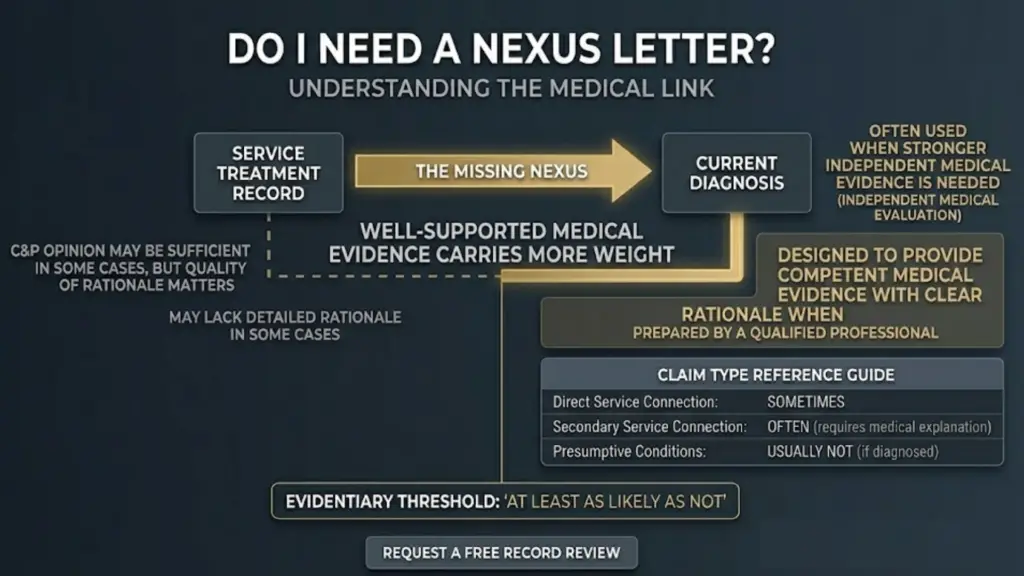
- Not every VA disability claim requires a nexus letter. The question is whether the medical evidence clearly explains the connection between a veteran's condition and their military service.
- Secondary service connection claims most often require a formal nexus opinion because the VA needs medical reasoning showing how one condition contributed to another.
- Presumptive conditions based on recognized service exposures typically do not require a separate nexus opinion when the diagnosis and qualifying service are documented.
- A full psychological IME includes a nexus opinion within a structured clinical evaluation: 50 to 90 minute interview, records review, DSM-5-TR diagnostic assessment, and documented medical rationale.
- The strength of any nexus opinion depends on the depth of the clinical work behind it. A conclusion without reasoning carries less evidentiary weight under 38 CFR §3.159.
- What a Nexus Letter Means in a VA Disability Claim
- Do All VA Disability Claims Require a Nexus Letter?
- Nexus Letter vs. DBQ in VA Disability Claims
- When a Full IME May Be Used Instead
- How VA Raters Evaluate Medical Nexus Opinions
- Why Some Nexus Letters Carry Less Evidentiary Weight
- Common Situations Where Veterans Ask If They Need a Nexus Letter
- Evidence, Not Promises
- Common Questions
Dr. Willoughby & Associates is a practice of licensed PhD and PsyD psychologists who conduct psychological Independent Medical Examinations for veterans pursuing VA disability claims. We have a direct interest in this topic, and we want to name that clearly.
This is a decision guide: it covers when a nexus opinion is typically needed and when it may not be. Our practice provides full psychological IMEs. That creates an obvious tension worth acknowledging — we are explaining a spectrum of evidence while offering one type of it.
Our position is not that every veteran needs a full IME. When service treatment records are strong and the nexus is already clear, simpler evidence is often sufficient. This article is written to inform that decision, not to make it for you.
Treating Provider Note
May support a claim when service records are already strong. Clinical rationale is typically limited.
Nexus Letter
States a service connection opinion. Evidentiary strength depends entirely on the clinical depth behind it.
Disability Benefits Questionnaire (DBQ)
Structured VA form. Documents findings but narrative depth and rationale vary significantly by provider.
Full Psychological IME
Clinical interview, comprehensive records review, DSM-5-TR diagnostic assessment, and documented medical rationale. Most comprehensive form of independent medical evidence.
Many cases begin with a treating provider note or nexus letter — and that is appropriate when the record already supports the claim. When stronger independent medical evidence is needed, a full psychological IME may be the right next step. The level of evaluation often determines how much weight the opinion carries on review or appeal.
What a Nexus Letter Means in a VA Disability Claim
In VA disability law, a nexus refers to the medical link between a veteran's current diagnosed condition and their military service. A nexus letter is a written medical opinion explaining that relationship — helping VA adjudicators understand whether the evidence supports a causal connection between service and the current disability.
Without a clear nexus, even documented medical conditions may not qualify for service connection.
For a deeper dive into nexus letters and how they compare to full IMEs, read: VA Mental Health Nexus Letters: What They Are and How They Compare to DBQs and IMEs
What "At Least as Likely as Not" Means
Medical opinions express the nexus using the phrase "at least as likely as not" — a defined evidentiary threshold reflecting a 50 percent or greater probability that the condition is related to military service. Under 38 CFR §3.159, competent medical evidence must come from a qualified provider and include sufficient reasoning to explain how the conclusion was reached.
A nexus is not a form you fill out. It is a medical determination earned through the evaluation behind it. The conclusion is only as strong as the clinical work that produced it. A conclusion without reasoning carries significantly less evidentiary weight.
Do All VA Disability Claims Require a Nexus Letter?
Not every VA disability claim requires a separate nexus letter. The need depends primarily on the type of service connection being pursued and the completeness of the existing record.
To learn more about the forum advice circulating on nexus letters and what is actually true, read our full breakdown.
| Claim Type | Nexus Opinion Needed? | Typical Evidence Used |
|---|---|---|
| Direct Service Connection | Sometimes | Service treatment records, C&P exam |
| Secondary Service Connection | Often | Medical nexus opinion explaining the relationship between conditions |
| Presumptive Conditions | Usually not | Diagnosis and documentation of qualifying service exposure |
| Denied or Appealed Claims | Often helpful | Independent medical opinion, often through a structured IME |
When service treatment records clearly document the condition beginning during military service and symptoms have continued since, the nexus may already be established. A separate nexus opinion becomes more relevant when records are incomplete, symptoms developed gradually after service, or the C&P exam rationale was thin.
A nexus opinion is frequently required. The VA needs medical reasoning explaining how one service-connected condition contributed to the development of another. The opinion must explain the step-wise clinical progression — not simply state the connection. See our guide to secondary service connection for mental health conditions and how conditions like tinnitus can contribute to secondary mental health claims.
When a condition qualifies under a recognized presumptive category (Agent Orange, PACT Act exposures), the service connection is recognized by law. A separate nexus opinion is often unnecessary, but a formal diagnosis and documentation of qualifying service are still required.
When a prior opinion was unfavorable, incomplete, or lacked rationale, stronger independent medical evidence is typically pursued. A full psychological IME provides a more comprehensive evidentiary foundation — particularly at the supplemental claim or Board of Veterans' Appeals level.
Secondary service connection claims most often require a formal nexus opinion because the VA needs medical reasoning showing how one condition led to another. Presumptive conditions typically do not. The type of claim is the first factor to evaluate when deciding whether additional medical evidence is needed.
Free Interactive VA Mental Health Evidence Review
Answer 6 brief questions to understand whether your file may need stronger independent medical evidence. No email required to view your result.
Nexus Letter vs. DBQ in VA Disability Claims
Two types of medical documents are often discussed in VA disability claims: nexus letters and Disability Benefits Questionnaires (DBQs). They are sometimes confused, but they serve different purposes. Veterans comparing all three evidence types can review our detailed breakdown explaining the differences between nexus letters, DBQs, and full Independent Medical Examinations.
Documents the severity of a disability. A structured VA form with checkboxes and standardized sections covering symptoms, functional limitations, and clinical findings. Helps VA raters determine how severe a condition is and what disability rating may apply. Does not always contain a detailed explanation of service connection.
Explains whether a condition is connected to military service. Requires review of relevant records, clinical evaluation or interview, diagnostic analysis when appropriate, and medical reasoning explaining the connection. It addresses a different question than the DBQ.
A DBQ answers: how severe is this condition? A nexus opinion answers: is this condition connected to military service? They address different parts of a claim. Some claims benefit from both. A full psychological IME includes a nexus opinion within a complete clinical evaluation and can incorporate a DBQ if needed.
Not the label on the document. The VA evaluates how well the opinion is supported — its probative value under 38 CFR §3.159. An opinion without documented rationale may be considered and still discounted.
| Criterion | Nexus Letter | DBQ | Psychological IME |
|---|---|---|---|
| Primary Purpose | △Service connection opinion | △Documents severity | ✓Full clinical evaluation plus nexus opinion |
| Length | △Typically 1–2 pages | △VA form, varies | ✓5–8 page report |
| Clinical Interview | △Often not included | △Varies | ✓50–90 minutes |
| DSM-5-TR Diagnosis | △Often not documented | △Required, rationale varies | ✓Yes, when clinically indicated |
| Appeal Strength | △Often less robust | △Varies | ✓Most comprehensive |
When a Full Independent Medical Examination (IME) May Be Used Instead
Some veterans pursue a more comprehensive medical evaluation known as an Independent Medical Examination (IME) when a claim requires clearer independent medical evidence. The key difference is the depth of medical analysis supporting the opinion.
These evaluations are typically pursued when a claim was previously denied, a C&P exam was brief or lacked explanation, conflicting medical opinions exist in the record, or the case involves complex medical history.
A licensed psychologist reviews your service and medical records and tells you plainly whether stronger independent evidence is likely to help your claim. No fee. No obligation.
A structured evaluation conducted by a W-2 licensed PhD or PsyD psychologist via HIPAA-compliant telehealth. Not a screening. A full clinical interview exploring symptom history, trauma exposure, and functional impact.
Where clinically indicated, a formal diagnostic assessment documenting how diagnostic criteria are met. Integrated with the full records review to establish a complete clinical picture.
A 5 to 8 page report with a clearly documented nexus opinion and medical rationale structured to meet VA evidentiary standards under 38 CFR §3.159. Conducted by W-2 licensed PhD and PsyD psychologists — employees of the practice, never contractors.
A full psychological IME includes a nexus opinion, but it goes further. The IME documents the clinical work behind the opinion: records reviewed, diagnostic reasoning, symptom history, and functional impact analysis. That documented thoroughness is what VA adjudicators and appeals boards weigh when evaluating competing medical opinions.
How VA Raters Evaluate Medical Nexus Opinions
When the VA reviews medical opinions, adjudicators consider the probative value of the evidence — how persuasive and well-supported it is. If a nexus opinion is pursued, its durability often depends entirely on how it was developed.
Comprehensive Records Review
The opinion documents which service and medical records were reviewed and integrates them into the clinical reasoning. Opinions based on limited or undocumented record review carry less probative value.
Clear Diagnostic Formulation
A DSM-5-TR assessment explains how the criteria are met and why. Confirming a diagnosis without explaining the basis leaves a gap that VA examiners and reviewers can challenge.
Documented Symptom History
The opinion explains when symptoms began, how they progressed over time, and how they connect to the in-service event or stressor. Gaps in this timeline are a common basis for denial.
Functional Impairment Analysis
VA ratings are tied to how symptoms affect occupational and social functioning. An opinion that names a diagnosis without documenting its daily impact leaves the rating decision without the evidence it needs.
Stated Probability in VA-Recognized Language
The nexus conclusion uses the "at least as likely as not" threshold under 38 CFR §3.159 and explains the reasoning behind that conclusion.
38 CFR §3.159 and Probative Value
Under 38 CFR §3.159, competent medical evidence must be provided by a qualified provider and must include sufficient explanation for the conclusion reached. Opinions that simply state a conclusion without explaining the reasoning may carry less evidentiary weight than those that document the clinical analysis behind it.
VA adjudicators evaluate medical opinions based on how thoroughly and clearly the reasoning is documented — not simply whether an opinion was submitted. The five factors above are what distinguish a well-supported opinion from one that is vulnerable to challenge on review or appeal.
Why Some Nexus Letters Carry Less Evidentiary Weight
Not all nexus letters are developed in the same way. The strength of a medical opinion often depends on the method used to produce it.
You may not need a full IME if:
- Your condition is clearly documented in service treatment records
- Symptoms have been continuous since separation with ongoing treatment
- Your claim involves a presumptive condition with qualifying service
- A prior C&P exam was favorable with thorough rationale
You may need stronger independent evidence if:
- Your claim was previously denied
- A C&P exam was unfavorable or the rationale was thin
- Your condition is secondary to a service-connected condition
- Symptoms appeared years after separation with limited documentation
- There is no clear documentation tying your condition to service
- You have no established treating provider
Some nexus letters rely on standardized templates with minimal customization. The VA has shown increased scrutiny toward opinions that appear formulaic or rely on generic language rather than individualized clinical reasoning. Opinions carry greater evidentiary weight when the analysis is clearly tailored to the veteran's specific medical history, service records, symptom progression, and functional impairment.
Opinions based on limited record review without a structured clinical evaluation may miss clinical context that is not apparent from the records alone. Additional clinical information from a structured interview often provides evidence that strengthens the medical reasoning.
The most common limitation in weaker nexus letters is the absence of clear medical reasoning. A conclusion without explanation may leave VA adjudicators uncertain about how the opinion was reached. Because VA disability decisions are evidence-driven, the clarity of the medical reasoning plays an important role in how opinions are evaluated.
A poorly supported IME does not outperform a poorly supported nexus letter. The format does not carry the weight. The reasoning does. What matters is whether the opinion clearly documents how the evidence supports the conclusion — regardless of what the document is called.
Common Situations Where Veterans Ask If They Need a Nexus Letter
Secondary Conditions
Secondary claims require a medical explanation connecting two conditions. When a service-connected condition contributes to a separate medical issue that develops later, the VA needs medical reasoning showing the documented clinical progression.
Service-Connected Physical Condition
Tinnitus, chronic pain, orthopedic injury, headaches, or other recognized condition
Chronic Disruption to Daily Functioning
Sleep disruption, reduced activity, social withdrawal, occupational stress, loss of prior abilities
Mood and Psychological Dysregulation
Persistent low mood, heightened anxiety, irritability, reduced emotional resilience, loss of motivation
Clinically Diagnosable Mental Health Condition
Major depressive disorder, generalized anxiety disorder, adjustment disorder, or related condition
The pathway itself is not the medical opinion. It represents the clinical reasoning that must be documented through a structured interview, records review, and diagnostic assessment to carry evidentiary weight. Without that documentation, the pathway is a hypothesis. With it, it becomes competent medical evidence.
Mental Health Claims
Mental health claims can involve complex symptom histories that evolve over time. In some cases, medical opinions help clarify how trauma, stress exposure, or service-related experiences contributed to the development of a diagnosable mental health condition. Each condition has its own evidentiary and diagnostic questions. Select a condition below to read a detailed guide specific to your claim.
Conflicting C&P Exams
Some veterans seek additional medical opinions after receiving an unfavorable or incomplete C&P examination. When multiple medical opinions exist in the record, adjudicators evaluate which opinion provides the most complete and well-reasoned analysis of the evidence.
Secondary claims, complex mental health histories, and prior denials are the three situations where veterans most commonly benefit from stronger independent medical evidence. In each case, the question is the same: does the existing record clearly explain the medical connection, or does it leave a gap that a VA adjudicator or reviewer can challenge?
Evidence, Not Promises
The VA disability system ultimately operates on evidence. A nexus letter or medical opinion cannot guarantee a specific outcome. However, when a claim requires a clear medical explanation connecting a condition to military service, a well-reasoned opinion can help clarify the evidentiary record.
A poorly supported IME does not outperform a poorly supported nexus letter. The format does not carry the weight. The reasoning does. Dr. Willoughby & Associates conducts psychological Independent Medical Examinations focused on veterans' mental health disability claims. Our evaluations produce structured medical reports designed to meet VA evidentiary standards when supported by the available medical evidence.
This article is provided for educational purposes and does not constitute medical treatment or legal advice.
Not Sure What Evidence Your Claim Needs?
Request a free preliminary record review. A licensed psychologist reviews your file and tells you plainly whether stronger independent evidence is likely to help. No fee. No obligation. No pressure to proceed.
Request a Free Record Review No fee • No obligation • No pressure to proceedFrequently Asked Questions
Not always. Veterans need competent medical evidence that meets VA evidentiary standards under 38 CFR §3.159. The question is not whether the document is titled "nexus letter" but whether the medical evidence clearly explains the connection between the veteran's condition and their military service. The type of claim and completeness of the existing record are the most important factors to evaluate.
"At least as likely as not" reflects a 50 percent or greater probability standard used throughout VA disability law. It is not casual wording. It is a defined evidentiary threshold. A medical opinion using this language is stating that the available evidence supports a connection between the condition and military service at that probability level or above. The opinion must also include sufficient explanation for how that conclusion was reached — not simply state it.
A nexus letter states a service connection conclusion. A full psychological IME includes that nexus opinion within a structured clinical evaluation: a 50 to 90 minute clinical interview, comprehensive records review, DSM-5-TR diagnostic assessment, and detailed medical rationale. One states the opinion. The other documents the clinical work behind it. That documented work is what VA adjudicators and appeals boards evaluate when opinions conflict. See our guide on VA mental health nexus letters, DBQs, and IMEs.
Nexus opinions are less commonly required when a condition qualifies as a presumptive condition based on specific service exposures, when service treatment records clearly document the condition and symptoms have continued since, or when a prior C&P exam was favorable and thorough. The need varies significantly by claim type and the completeness of the existing record. A free preliminary record review is the right first step for veterans who are uncertain.
The strength of a nexus opinion depends on the depth of the clinical work behind it. Template letters with generic language, opinions based on limited or no clinical interview, and conclusions without documented medical rationale all tend to carry less probative value. VA adjudicators evaluate how clearly and thoroughly the evidence supports the conclusion. The format of the document does not determine its weight. The reasoning does.
No. We produce evidence. The VA makes decisions. We do not guarantee claim outcomes. A psychological IME is a thorough, clinically rigorous medical evaluation designed to produce competent evidence that meets VA evidentiary standards. Claim outcomes depend on many factors beyond any single piece of evidence, including the full record, adjudicator decisions, and applicable law. Any provider that guarantees specific outcomes should be approached with caution.
Learn More About VA Medical Evidence
These guides cover how medical evidence is evaluated in VA disability claims, how different evaluation types compare, and what your specific claim may need.
Dr. Crystal Willoughby is a Maryland-licensed clinical psychologist and the founder of Dr. Willoughby & Associates. Her work focuses on psychological assessment and independent medical examinations for veterans nationwide, with experience evaluating PTSD, depression, anxiety, trauma-related conditions, and functional impairment within the context of VA disability claims.
Dr. Amanda Barrow is a licensed clinical psychologist and Director of Veteran Services at Dr. Willoughby & Associates. She specializes in psychological evaluation and assessment of veterans pursuing VA disability claims, with expertise in trauma, mood, and anxiety-related conditions.
Dr. Willoughby & Associates is PSYPACT certified. Psychological IMEs are available via HIPAA-compliant telehealth in most U.S. states. Services are also available in additional states where our clinicians hold individual licensure.
This content is for educational purposes only and does not constitute medical treatment or legal advice. We produce evidence. The VA makes decisions. We do not guarantee claim outcomes.