
When Tinnitus Contributes to Mental Health Conditions in VA Disability Claims
Written by: Dr. Crystal Willoughby, PsyD, Licensed Clinical Psychologist, Founder
Professionally reviewed by: Dr. Amanda Barrow, PhD, Licensed Clinical Psychologist, Director of Veteran Services

Tinnitus is one of the most commonly service-connected conditions among U.S. veterans.
The condition is typically assigned a 10 percent disability rating, which is the maximum evaluation available under VA Diagnostic Code 6260.
Because the rating for tinnitus is limited, some veterans ask whether tinnitus can support secondary service connection for mental health conditions such as depression or anxiety.
In some cases, it can.
The key issue is not simply whether tinnitus exists.
The question is whether the medical evidence shows that tinnitus has contributed to a clinically diagnosable mental health condition and measurable functional impairment.
Understanding how that connection is evaluated can help clarify why some medical opinions carry more evidentiary weight than others.
Secondary Service Connection in VA Disability Claims
Under VA disability law, a condition may be service-connected if it is caused or aggravated by an already service-connected condition.
This is known as secondary service connection.
In a claim involving tinnitus and a mental health condition, the evidence typically must establish three elements:
- A current mental health diagnosis
- A service-connected primary condition (such as tinnitus)
- A medical nexus explaining how the primary condition contributed to the secondary condition
The nexus opinion must include medical reasoning supported by evidence, not simply a conclusion.
Why the Medical Explanation Matters
Veterans often hear simplified advice online such as:
“Just get a nexus letter connecting tinnitus to anxiety.”
In practice, VA adjudicators evaluate the reasoning behind the opinion, not just the statement itself.
In VA disability evaluations, the strength of a medical opinion often depends on how clearly the relationship between conditions is explained.
Some opinions describe a direct causal relationship, while others document a step-wise progression of symptoms over time.
Both approaches may be appropriate depending on the individual case and the available medical evidence.
Direct vs Step-Wise Clinical Pathways
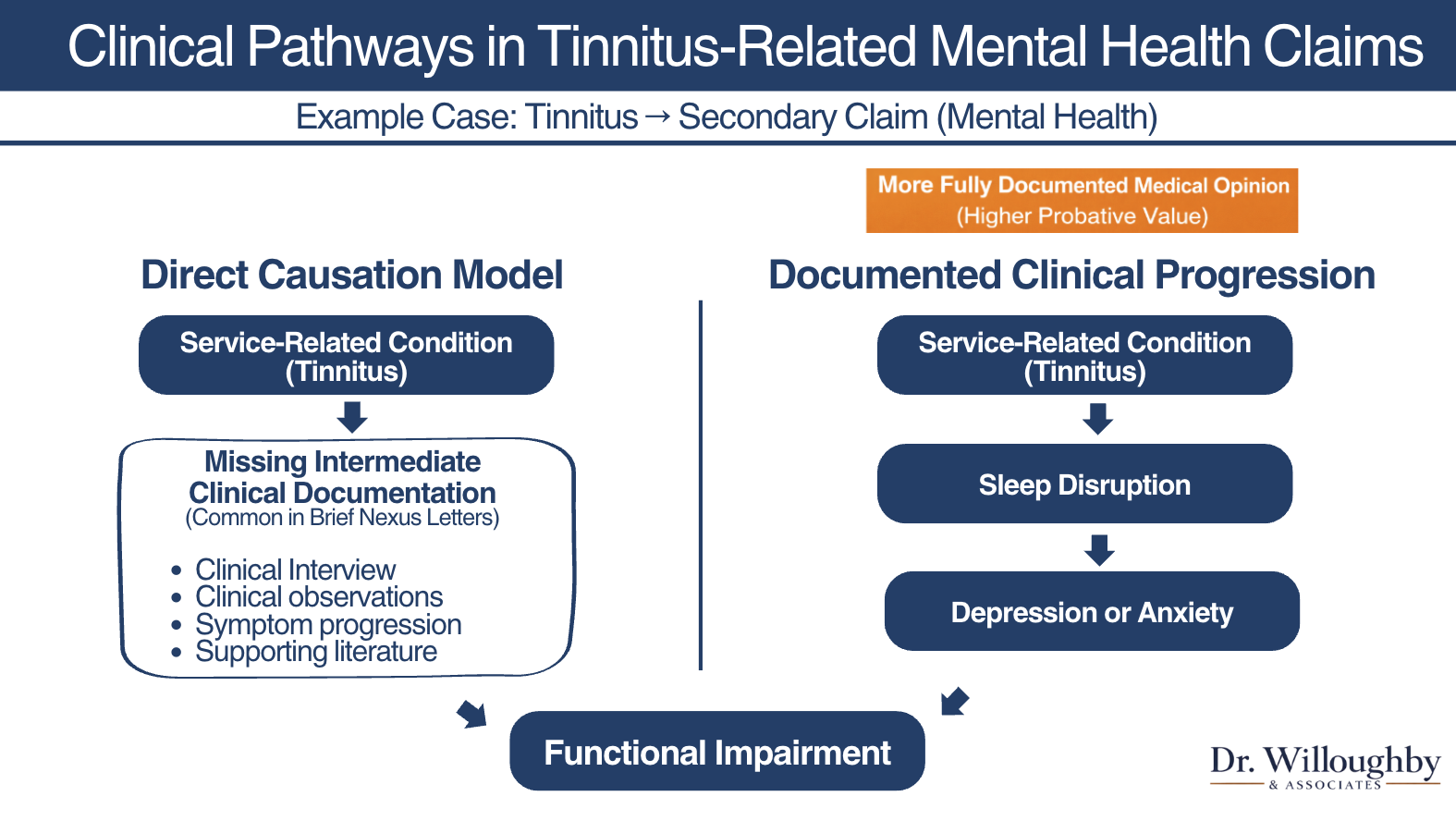
Below is a simplified illustration of how tinnitus-related impairment may be described within a medical opinion. Medical opinions may describe the relationship between tinnitus and mental health symptoms through either a direct causation pathway or a step-wise clinical progression involving factors such as sleep disruption.
Clinician Explainer
In some tinnitus-related disability evaluations, the connection to mental health symptoms may develop through a progression of symptoms rather than a single direct step.
Persistent tinnitus can interfere with sleep for some individuals.
Chronic sleep disruption may contribute to fatigue, mood symptoms, and reduced emotional regulation over time.
When this progression is documented through clinical interview, record review, and diagnostic assessment, it can help explain how tinnitus symptoms may contribute to functional impairment.
The key factor is not the diagram itself, but the clinical reasoning and supporting evidence used to explain the relationship between conditions.
How VA Adjudicators Evaluate Medical Opinions
When reviewing medical opinions involving tinnitus and secondary mental health conditions, VA adjudicators typically consider several factors.
These may include:
- Whether a diagnosis is documented using DSM-5-TR criteria
- Whether relevant service and medical records were reviewed
- Whether the timeline of symptoms is explained
- Whether functional impairment is described
- Whether the medical rationale clearly connects the evidence to the conclusion
An opinion that explains how and why symptoms progressed may carry more evidentiary weight than a brief statement that does not document the underlying analysis.
Ultimately, VA disability evaluations focus on how symptoms affect occupational functioning and daily life.
When a Comprehensive Psychological Evaluation May Be Helpful
Some veterans obtain a brief nexus letter addressing the connection between tinnitus and mental health symptoms.
Others pursue a comprehensive psychological Independent Medical Examination (IME) that documents the diagnosis, nexus opinion, and supporting clinical rationale within a structured evaluation.
A comprehensive evaluation typically includes:
- Review of relevant service and medical records
- A structured clinical interview
- DSM-5-TR diagnostic assessment
- Functional impact analysis
- A written medical opinion explaining the connection between conditions when supported by the evidence
The difference is not the title of the document.
The difference is the depth of clinical documentation supporting the opinion.
Evidence, Not Promises
The VA disability system evaluates medical evidence and clinical reasoning.
A well-supported medical opinion may strengthen a claim when the clinical evidence supports the connection between conditions.
It cannot guarantee a specific outcome.
Veterans considering a mental health evaluation related to tinnitus should understand the importance of clear diagnostic documentation and medical rationale when pursuing a secondary service connection claim.
Related Educational Resources
Learn more about how medical evidence is evaluated in VA disability claims:
How Nexus Opinions Are Evaluated: Understanding VA Evidence, IMEs, and Nexus Opinions
Nexus Letters vs. IMEs: Why Strong Evidence Requires More Than a 20-Minute Interview
What is Competent Evidence: 38 CFR § 3.159 Explained
Defining the Nexus: What is a VA Nexus Letter?
These resources explain how medical documentation, diagnostic analysis, and clinical reasoning contribute to the evidentiary record reviewed by VA adjudicators.
Dr. Willoughby & Associates is a specialized Independent Medical Examination practice focused on Veterans’ mental health VA disability claims. Our licensed PhD and PsyD clinicians conduct full psychological IMEs producing comprehensive medical evidence that connects conditions to military service when supported by the record.
While many Veterans are familiar with nexus letters, a full IME includes the medical nexus opinion within a complete clinical evaluation, creating one of the most comprehensive forms of medical evidence used in VA disability claims.
Our Education Hub covers Independent Medical Examinations, nexus letters, PTSD and other service-connected mental health conditions, secondary conditions, VA C&P examinations, and claim strategy in plain language.
This content is provided for educational purposes and does not constitute medical treatment or legal advice.
About the Author
Dr. Crystal Willoughby, PsyD, is a Maryland-licensed clinical psychologist and the founder of Dr. Willoughby & Associates. Her work focuses on psychological assessment and independent medical examinations for Veterans nationwide, with experience evaluating PTSD, depression, anxiety, trauma-related conditions, and functional impairment within the context of VA disability claims.