
Nexus Letter for PTSD
How the VA Evaluates PTSD Nexus Letters in Disability Claims
Written by Dr. Crystal Willoughby, PsyD, Licensed Clinical Psychologist, Founder
Professionally reviewed by Dr. Amanda Barrow, PhD, Licensed Clinical Psychologist, Director of Veteran Services

Posttraumatic stress disorder (PTSD) is one of the most commonly claimed mental health conditions in VA disability claims.
If you’re searching for a PTSD nexus letter, you may be trying to understand whether the medical evidence in your claim clearly connects your current condition to your military service.
In practice, a PTSD nexus letter is a medical opinion written by a qualified clinician explaining whether a veteran’s PTSD is “at least as likely as not” (50 percent or greater probability) related to military service or to another service-connected condition.
Under VA evidentiary standards, a diagnosis alone does not establish service connection. The record must also include competent medical evidence explaining how the condition is connected to military service.
If you want a deeper explanation of how nexus opinions work across mental health claims, see our full guide to VA Mental Health Nexus Letters and Independent Medical Examinations.
This article focuses specifically on PTSD nexus letters and how PTSD evidence is evaluated in VA disability claims.
What You’ll Learn on This Page (7-minute read)
- What Is a PTSD Nexus Letter?
- Do I Need a Nexus Letter for PTSD?
- Direct Service Connection for PTSD
- Secondary Service Connection for PTSD
- DSM-5-TR Diagnosis and Clinical Assessment of PTSD
- When a C&P Exam Conflicts With the Clinical Evidence
- Common Evidence Gaps in PTSD Claims
- How VA Decision Makers Evaluate Medical Opinions
- Psychological Independent Medical Evaluations (IME)
What Is a PTSD Nexus Letter?
In VA disability claims, a nexus is the medical opinion that connects a diagnosed condition to military service.
A PTSD nexus letter explains how your current PTSD is connected to something that happened during military service.
For PTSD, this opinion typically evaluates:
- the veteran’s trauma exposure or stressor
- the current PTSD diagnosis
- the veteran’s symptom history
- whether the evidence supports a “at least as likely as not” relationship to service
The strength of the nexus opinion depends on how clearly the medical reasoning and evidence are documented.
The Three Elements Required for Service Connection
For the VA to grant disability benefits, a typical PTSD claim must establish three things
- a current diagnosis
- an in-service stressor or traumatic event
- a medical nexus connecting the two.
A nexus opinion explains why the clinician believes the condition is related to service based on medical evidence and clinical evaluation.
Do I Need a Nexus Letter for PTSD?
If you’re filing a PTSD claim, your record may already include treatment records or prior diagnoses.
However, VA decision makers still evaluate whether the evidence clearly explains the connection between PTSD and military service.
A nexus letter or comprehensive medical evaluation may be used when the record does not clearly explain:
- how the stressor relates to the diagnosis
- when symptoms began
- whether the evidence supports a service connection opinion
The key issue is not simply having a diagnosis, but whether the medical evidence clearly explains the relationship between PTSD and military service.
Direct Service Connection for PTSD
Direct service connection is defined as the trauma that caused PTSD happened during military service.
Examples might include:
- combat exposure
- military accidents
- witnessing traumatic events
- military sexual trauma (MST)
A medical evaluation examines:
- the nature of the stressor
- he timing of symptoms
- whether diagnostic criteria for PTSD are met
- whether the evidence supports a connection between the trauma and the current condition.
When supported by clinical findings, the medical opinion may conclude the PTSD is “at least as likely as not” related to military service.
Secondary Service Connection for PTSD
Sometimes PTSD develops because of another service-connected condition.
For example, a veteran with chronic service-connected injuries may develop PTSD or trauma-related symptoms connected to:
- severe injuries
- life-threatening medical events
- chronic pain and stress
In secondary claims, the clinician evaluates whether the existing service-connected condition caused or contributed to the psychiatric condition.
The medical opinion must explain the clinical relationship between the conditions.
It is also common for PTSD to be aggravated by, or secondary to, existing physical service-connected disabilities.
For example, many Veterans find that the constant ringing of tinnitus can contribute to secondary mental health conditions like anxiety or depression, which can exacerbate PTSD symptoms.
In these cases, a nexus letter must clearly define the psychological link between the two conditions.
Aggravation of PTSD Pre-Existing Mental Health Conditions
In some cases, mental health challenges existed before service and became significantly worse during military service.
VA law allows service connection if military service aggravated a condition beyond its natural progression.
This is called Aggravation.
Medical evaluations may analyze:
- symptom history before service
- changes during or after service
- medical records documenting worsening symptoms
The opinion must explain how service contributed to the worsening of the condition.
Combat vs Non-Combat Stressor Evidence in PTSD Claims
The VA evaluates combat-related trauma differently from non-combat trauma.
For combat veterans, the VA may accept the stressor if it is consistent with the circumstances of service.
For non-combat trauma, evidence may include:
- service records
- witness statements
- medical records
- behavioral changes documented during service
The clinician evaluates how the reported trauma relates to the diagnosis and symptom development.
DSM-5-TR Diagnosis and Clinical Assessment of PTSD
A PTSD nexus letter or evaluation typically relies on DSM-5-TR diagnostic criteria when determining whether a Veteran meets the medical standard for PTSD.
A PTSD diagnosis follows a specific medical standard used by mental health professionals.
VA mental health evaluations typically reference the DSM-5-TR (Diagnostic and Statistical Manual of Mental Disorders).
Clinicians assess whether the diagnostic criteria are met, including:
- trauma exposure
- intrusive memories or flashbacks
- avoidance behaviors
- negative changes in mood or thinking
- hyperarousal symptoms
A diagnosis alone does not establish service connection.
The evaluation must also explain how the diagnosis relates to military service.
PTSD Functional Impairment and Occupational Impact in VA Ratings
Functional impairment is defined by how much a condition interferes with your ability to work and function in daily life.
VA disability ratings for mental health conditions depend heavily on functional impact.
Clinicians may document:
- difficulty maintaining employment
- impaired concentration or memory
- sleep disruption
- reduced reliability and productivity
- relationship difficulties
Think of it this way:
A diagnosis identifies the condition.
Functional impairment shows how much that condition affects your ability to function.
PTSD in Initial Claims vs Appeals
Veterans pursue PTSD evidence at different stages of the VA process.
Initial claims typically focus on establishing:
- the diagnosis
- the stressor
- the service connection
Appeals often occur when a claim was denied due to:
- lack of a clear nexus opinion
- conflicting medical evidence
- limited documentation of symptoms or functional impairment
At the appeal stage, the clarity of medical reasoning can become especially important.
When a C&P Exam Conflicts With the Clinical Evidence
Sometimes a VA Compensation and Pension (C&P) exam does not fully capture the veteran’s symptoms or history.
C&P exams are conducted for evaluation purposes and may vary in length and detail.
When medical opinions conflict, VA decision makers often consider:
- the scope of record review
- the length and structure of the clinical interview
- the clarity of diagnostic reasoning
- whether the opinion addresses the full medical record
Opinions supported by clear clinical reasoning and documentation may carry greater evidentiary weight.
Under 38 CFR § 3.159, competent medical evidence must be provided by a qualified medical professional and supported by sufficient clinical rationale.
Delayed Onset PTSD in VA Disability Claims
PTSD symptoms do not always appear immediately after trauma.
Some veterans develop significant symptoms years after military service.
Clinical evaluation may consider:
- earlier mild symptoms that worsened over time
- life stressors that triggered symptom escalation
- how trauma exposure relates to later psychological changes
Delayed onset does not prevent service connection, but it often requires careful medical explanation.
Common Evidence Gaps in PTSD Claims
Many PTSD claims are denied because the evidence does not clearly explain the connection to service.
Common issues include:
- a PTSD diagnosis without a clear nexus letter or nexus opinion
- limited documentation of functional impairment
- medical opinions without detailed rationale
- conflicting evaluations
Strengthening the evidentiary record often involves clarifying the clinical reasoning connecting the condition to service.
How VA Decision Makers Evaluate Medical Opinions
Not all medical opinions carry the same weight.
VA adjudicators often evaluate opinions based on factors such as:
- the records reviewed
- the diagnostic evaluation
- the clarity of the medical reasoning
- whether the opinion explains how the evidence supports the conclusion
An opinion that simply states a conclusion may carry less weight than one that documents the clinical analysis behind it.
For this reason, the strength of a PTSD nexus letter often depends on how clearly the medical reasoning and supporting documentation are explained.
Understanding the Role of a Psychological Independent Medical Evaluation
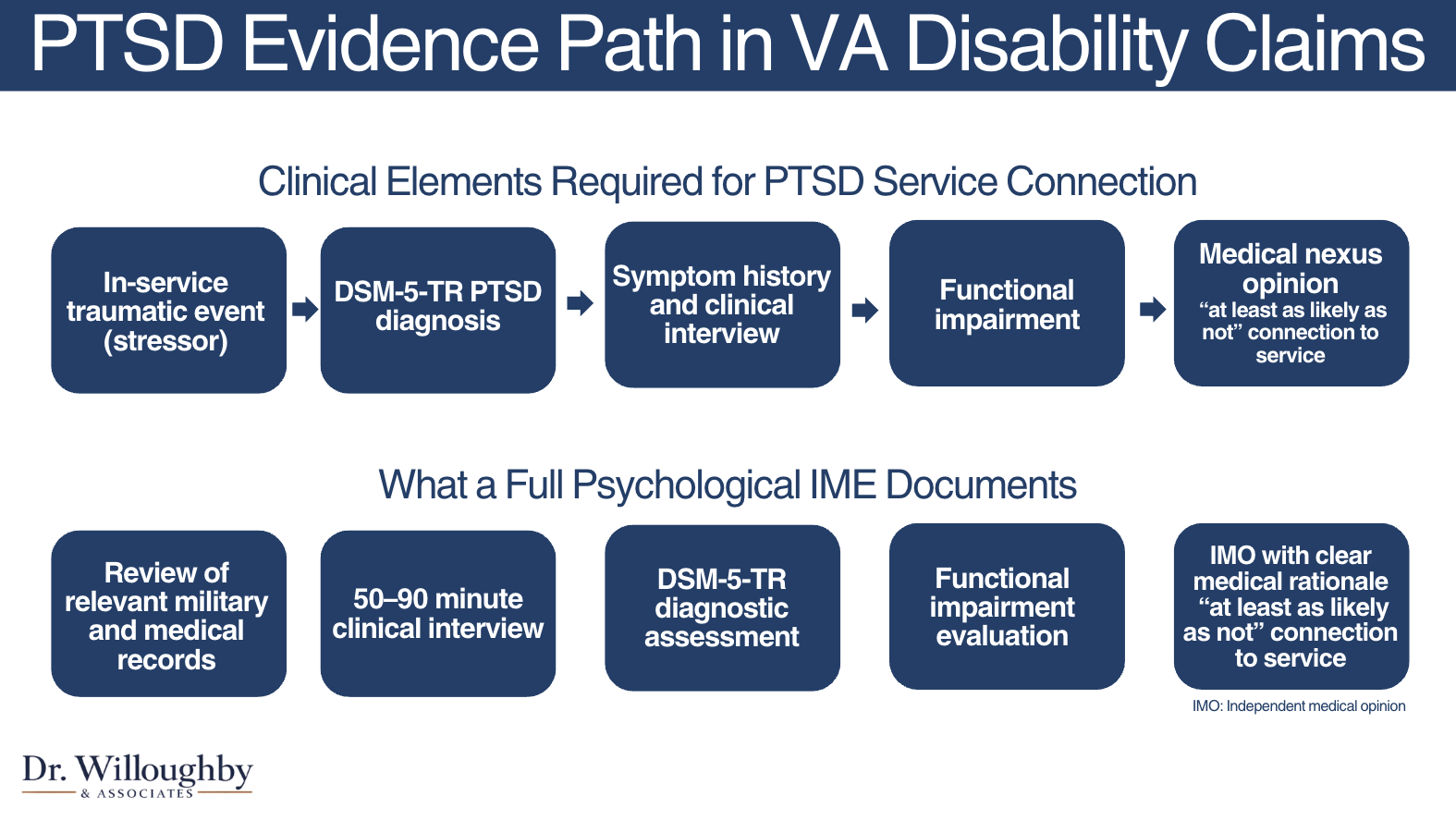
Some evaluations provide only a short letter summarizing an opinion. A comprehensive psychological evaluation typically includes:
- review of relevant military service and medical records
- a 50–90 minute clinical interview
- DSM-5-TR diagnostic assessment
- an independent medical opinion (“at least as likely as not” when supported)
- clear medical rationale explaining the clinical findings
The key difference is not the title of the document, but the depth of clinical evaluation supporting the opinion.
Considering a Psychological IME for Your PTSD Claim?
If you are evaluating whether additional medical evidence may be helpful in your case, you may request a free record review consultation with Dr. Willoughby and Associates. Licensed clinical psychologists experienced in PTSD and other trauma-related mental health conditions evaluated within VA disability claims, to determine whether a psychological IME evaluation may be clinically appropriate.
There is no fee for the consultation.
Trusted by VA Disability Attorneys
“After more than 15 years practicing VA disability law, I can say the mental health IME reports produced by Dr. Willoughby & Associates are among the most thorough and evidentiary-sound evaluations I have reviewed.”
David Leamon
Leamon Legal
Evidence, Not Promises
VA disability decisions involving PTSD nexus letters are based on evidence.
A well-reasoned medical opinion may strengthen a claim when the available information supports a clinically defensible connection between PTSD and military service.
No medical evaluation can guarantee a specific rating or outcome.
Understanding how PTSD evidence is evaluated allows veterans and attorneys to make more informed decisions about the medical documentation used in their claim.
Related Educational Resources
Learn more about how medical evidence is evaluated in VA disability claims:
How Nexus Opinions Are Evaluated: Understanding VA Evidence, IMEs, and Nexus Opinions
Nexus Letters vs. IMEs: Why Strong Evidence Requires More Than a 20-Minute Interview
What is Competent Evidence: 38 CFR § 3.159 Explained
Defining the Nexus: What is a VA Nexus Letter?
These resources explain how medical documentation, diagnostic analysis, and clinical reasoning contribute to the evidentiary record reviewed by VA adjudicators.
Dr. Willoughby & Associates is a specialized Independent Medical Examination practice focused on Veterans’ mental health VA disability claims. Our licensed PhD and PsyD clinicians conduct full psychological IMEs producing comprehensive medical evidence that connects conditions to military service when supported by the record.
While many Veterans are familiar with nexus letters, a full IME includes the medical nexus opinion within a complete clinical evaluation, creating one of the most comprehensive forms of medical evidence used in VA disability claims.
Our Education Hub covers Independent Medical Examinations, nexus letters, PTSD and other service-connected mental health conditions, secondary conditions, VA C&P examinations, and claim strategy in plain language.
This content is provided for educational purposes and does not constitute medical treatment or legal advice.
About the Author
Dr. Crystal Willoughby, PsyD, is a Maryland-licensed clinical psychologist and the founder of Dr. Willoughby & Associates. Her work focuses on psychological assessment and independent medical examinations for Veterans nationwide, with experience evaluating PTSD, depression, anxiety, trauma-related conditions, and functional impairment within the context of VA disability claims.